Compare patient experience across hospital departments
Compare nonclinical hospital service patterns by department with consistent context, without treating scores as proof of cause or staff fault.
Read the guideThumbsUp can be evaluated as a localized, non-clinical service pulse at an approved registration, outpatient, discharge, or facilities point. It is designed to complement formal patient-experience programs, not replace them.
For patient-experience leaders, quality teams, hospital operations, and facilities or EVS owners
Hospital privacy, accessibility, security, quality, and procurement owners should approve the complete setup before a patient-facing pilot.
Outside a clinical conversation
Patient or visitor reaches a pause point
Step 1 for the approved service point workflow
A brief service gesture is offered
Step 2 for the approved service point workflow
Team reviews department and time context
Step 3 for the approved service point workflow
Set one short service question.
More industry guides
Compare related service moments.
Compare nonclinical hospital service patterns by department with consistent context, without treating scores as proof of cause or staff fault.
Read the guideDesign a touchless feedback point for hospital discharge and identify nonclinical friction in the handoff experience.
Read the guideUse touchless feedback at a hospital pharmacy to surface waiting, wayfinding, and handoff friction without collecting clinical details.
Read the guideChoose a touchless feedback placement for hospital registration and find nonclinical friction in the arrival experience.
Read the guideWhy local service signals need their own lane
Hospitals already work with structured patient-experience programs. A carefully scoped physical prompt can help a team notice a local service pattern while leaving clinical care, formal survey rules, and patient privacy with their existing owners.
Registration, wayfinding, waiting, discharge, and facilities moments can have different owners and different operating causes.
A hospital setup must protect privacy, preserve dignity, and provide an alternative for people who cannot or do not want to use a camera-facing prompt.
A non-clinical service signal should not be presented as a diagnosis, treatment, nurse rating, or clinical-outcome measure.
A hospital pilot sequence
The quality of a hospital pilot depends as much on governance and placement as on the gesture itself.
Start with registration exit, outpatient waiting, discharge, wayfinding, or another service point with a clear owner.
Define what the prompt asks, where the device faces, who can review results, and what alternative channel is available.
Validate reach, lighting, distance, accessibility, and patient flow in the approved zone without interrupting care.
Review department and time patterns alongside queue, wayfinding, and facilities observations.
Deployment note: Do not place the device in a treatment conversation or use it to request health information. A hospital must complete its own privacy, accessibility, security, consent, procurement, and clinical-governance review.
Placement planning
Registration exits, outpatient waiting areas, discharge routes, and common facilities may offer different test conditions. The hospital should choose the point that matches the question and its governance plan.
From a pulse to a service question
The dashboard can organize configured device, location, and time context. The hospital team supplies the operational interpretation and decides whether a pattern deserves a closer look.
Compare approved service points and time periods to see where a recurring waiting or wayfinding question may sit.
Use a signal to decide where to check signage, room readiness, queue flow, or other non-clinical observations.
Keep local feedback alongside the hospital’s established HCAHPS, CAHPS, and patient-experience processes.
Illustrative outpatient check
If an outpatient waiting-area signal drops during a recurring period, quality staff review queue and wayfinding observations. They should not use that signal to infer a diagnosis, treatment result, nurse performance, or patient identity.
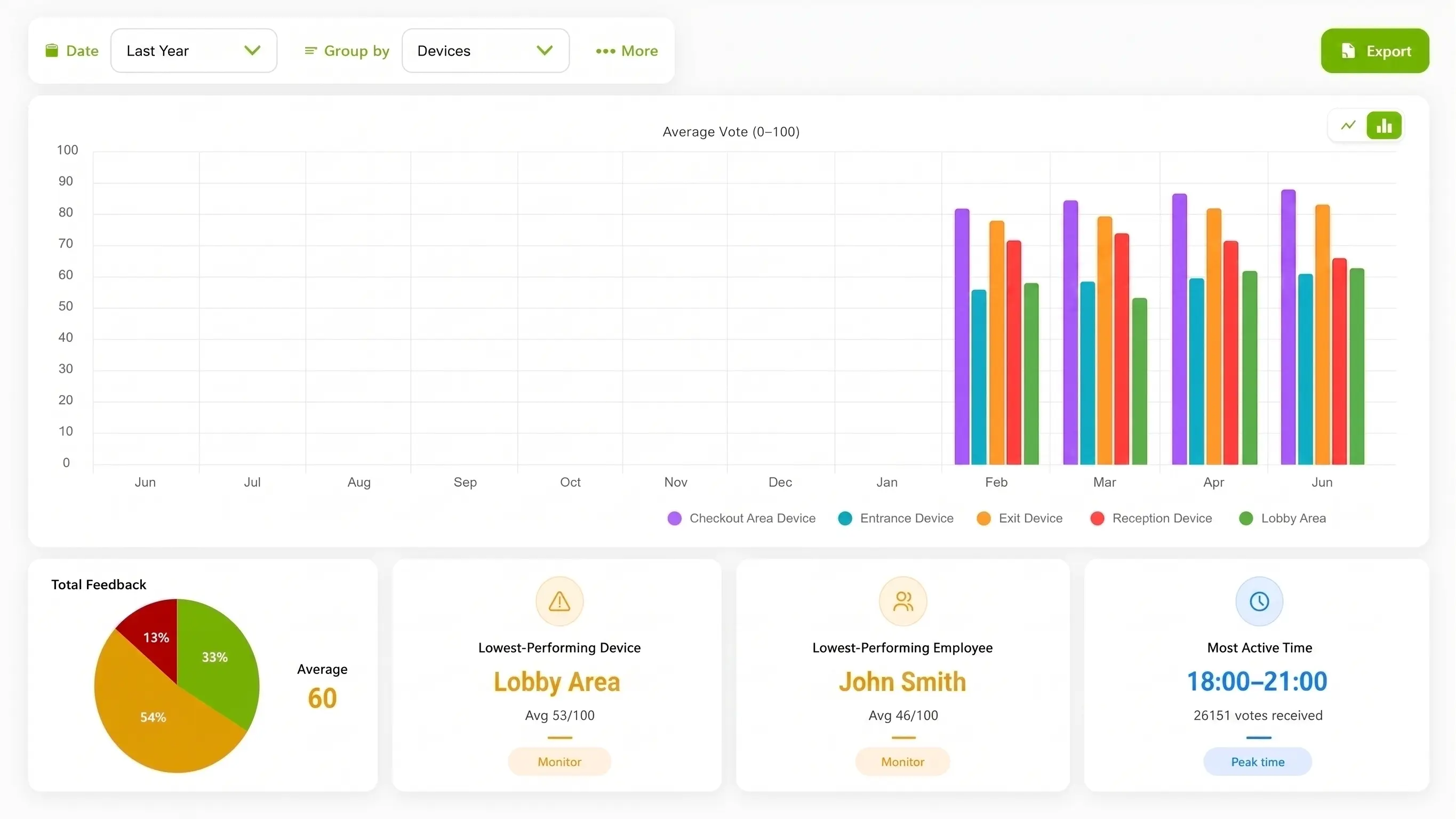
Illustration of configured review.
Choose the method for the moment
A hospital may need a structured survey, a phone follow-up, or a kiosk for a different question. The placement and governance review should decide which method belongs at each service point.
| Consideration | ThumbsUp | QR or phone survey | Shared kiosk |
|---|---|---|---|
| Customer action | Give a brief gesture at an approved non-clinical point. | Use a personal device to complete the chosen survey or follow-up. | Use a shared screen where the hospital has approved the interaction. |
| Setup question | Check camera view, distance, light, and pause. | Open the code and complete the form. | Reach the shared screen at the moment. |
| Manager view | Review device, location, time, and context. | Review fields from the survey workflow. | Review fields from the kiosk workflow. |
Evidence for rollout planning
An approved installation photo or clearly identified diagram can help a hospital team evaluate a non-clinical service zone. A captioned demonstration should show the pause point and dashboard context without patient data, treatment scenes, or identifiable signage.
Governance and product boundary
HCAHPS and CAHPS remain separate formal survey programs. A ThumbsUp pilot is a localized service-experience signal and needs the hospital’s own privacy, accessibility, security, consent, and procurement decisions before use.
Read the relevant product guidanceBuying questions
A hospital buying group should make the operational and governance questions explicit.
Questions before the pilot
Match setup to the service moment.
It is a brief, camera-facing gesture prompt at a hospital-approved service point such as registration, outpatient waiting, discharge, or a common-area exit. The intended signal is about a non-clinical service moment and must be evaluated in the hospital’s governance process.
No. HCAHPS and other formal patient-experience programs have their own purpose and process. A localized ThumbsUp signal can be considered as a complement for an approved operational question.
At a suitable pause point, a customer-facing Android tablet can invite a supported hand gesture instead of a shared touch interaction. The hospital must test camera view, distance, lighting, accessibility, flow, and the alternative channel.
A service pulse should not be interpreted as a diagnosis, treatment assessment, nurse rating, or clinical outcome. Teams should use clinical and formal quality methods for those questions.
Bring the approved service moment, governance owners, and operating question. We can map a test point and the product and privacy requirements to review.