Capture feedback at medical clinic checkout
Capture a quick, touchless signal at outpatient clinic checkout to learn whether next steps, scheduling, and the departure experience are clear.
Read the guideThumbsUp gives clinics a touchless way to invite feedback at a non-clinical service point such as reception or checkout. It complements detailed surveys and helps authorized teams review configured site and time patterns without evaluating diagnosis or treatment.
A healthcare pilot needs an approved fixed point, privacy and security review, accessible alternatives, careful consent language, and a clear separation from medical records and clinical decisions.
Choose a non-clinical moment
Offer a voluntary gesture
Confirm the response for clinics and outpatient centers
Set one short service question.
More industry guides
Compare related service moments.
Capture a quick, touchless signal at outpatient clinic checkout to learn whether next steps, scheduling, and the departure experience are clear.
Read the guideLearn how outpatient clinics can capture a quick, touchless signal about reception and check-in, then review patterns for service improvement.
Read the guideMeasure the outpatient waiting-room experience with a quick, touchless signal and use time and location patterns to guide practical clinic improvements.
Read the guideKeep the question non-clinical
Reception, waiting, checkout, wayfinding, and communication can be measured as service moments. A short pulse should be clearly separated from treatment quality, clinical outcomes, medical records, and a patient’s right to a richer feedback channel.
Invite a rating about a defined non-clinical moment. Do not describe it as an assessment of diagnosis, treatment, provider quality, or health outcome.
Use configured device and location labels to compare approved reception, waiting, or checkout points. Do not imply automatic patient or appointment tracking.
A recurring time pattern can guide a review of waiting observations, staffing, signage, or communication. It does not prove a medical or individual cause.
A respectful clinic interaction
The point should be away from consultation details, screens, and patient identifiers, with a clear alternative for people who cannot or do not want to use a gesture. Review the wording and placement with the clinic’s privacy and accessibility owners.
Place a compatible camera-equipped tablet at an approved reception, waiting, or checkout point away from confidential conversations.
A visitor gives a supported gesture without typing, scanning a phone, or touching a shared screen.
For clinics and outpatient centers, the confirmation display is configured to show for 1 second by default, according to current product documentation.
Authorized managers review configured device and period patterns alongside approved operational observations.
Reception-to-checkout map
Use a single, plain-language service question for the pilot. Keep urgent care, diagnostic, and specialist variations under the outpatient page until their requirements justify a separate experience.
ThumbsUp does not provide a HIPAA or BAA commitment, certification, medical-record linkage, or clinical compliance by itself. The exact camera field of view, consent language, and accessible alternative require clinic approval.
Invite a signal after the non-clinical check-in interaction, with the device outside private conversations and paperwork.
A point near the exit can focus on the waiting experience. Do not imply an appointment, queue, or patient-identity link unless approved and implemented.
Keep the prompt about the service handoff, explanation, or access process. Clinical instructions and medical questions need their own channels.
Use an approved, privacy-safe setup with no patient identity or treatment details in view. Any demonstration should make clear when the scene is staged.
Review the service pattern
A configured site and time pattern can help an administrator choose where to look next. Pair it with approved waiting-time observations, staffing records, wayfinding notes, and richer patient feedback channels.
Hypothetical clinic example
A clinic sees lower checkout scores during a recurring late shift. The administrator reviews waiting-time observations and staffing, without linking a score to a medical record or provider unless an approved configuration exists.
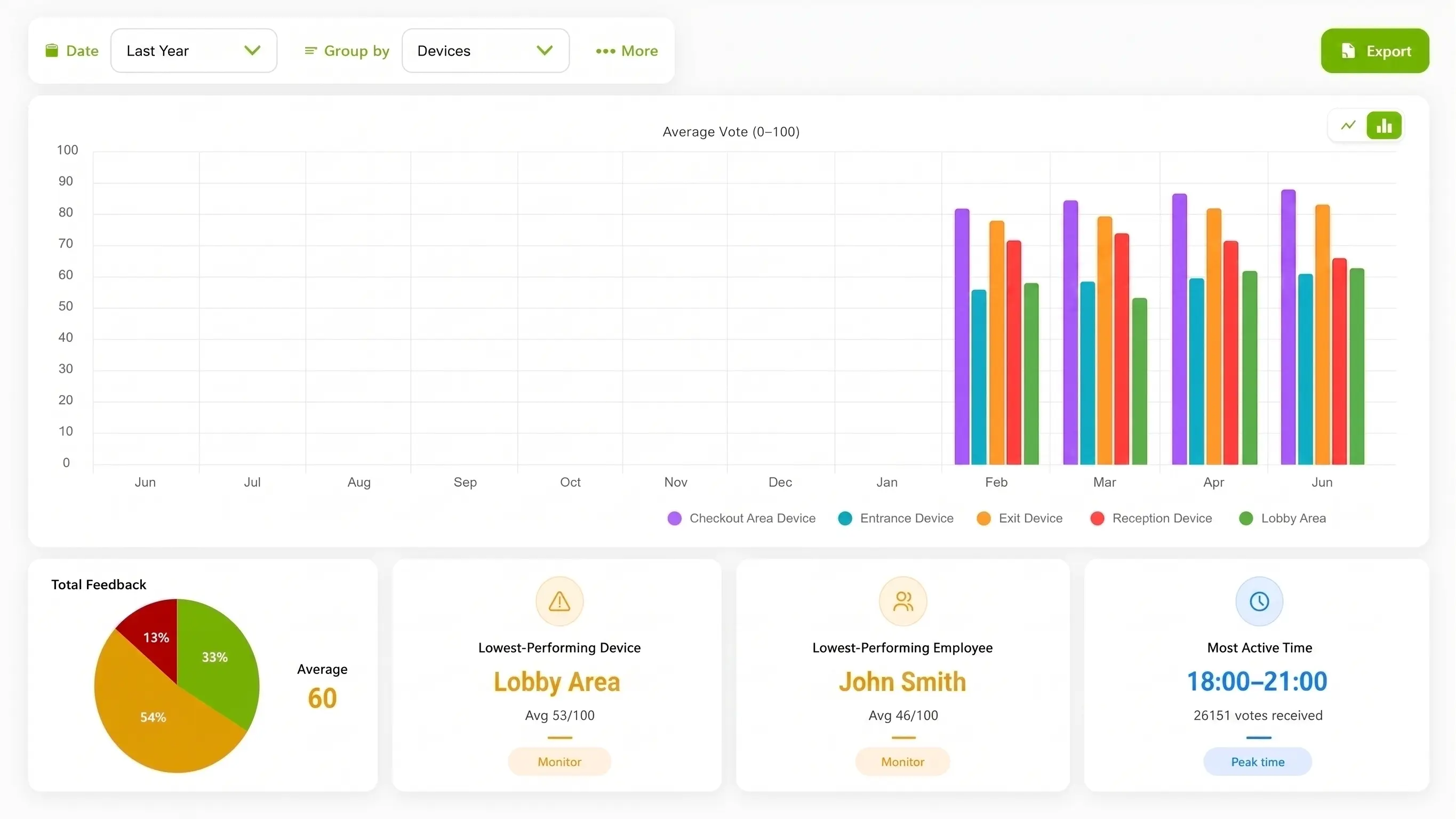
Use the dashboard to review configured clinic feedback devices and trends. The product interface image is illustrative and does not show patient data, a clinical result, or a healthcare integration.
Complement the survey program
A physical point can make a brief service signal available to visitors who do not want to type. Detailed surveys, formal patient-experience programs, complaints, and accessibility channels still have distinct roles.
| Consideration | ThumbsUp | QR or SMS survey | Existing service process |
|---|---|---|---|
| Patient action | Give a voluntary gesture at an approved non-clinical point | Complete a detailed post-visit or CAHPS-style survey | Use reception, complaint, accessibility, or care-team channels |
| Best fit | A short signal about reception, waiting, checkout, or access | Rich questions, comments, follow-up, and program reporting | A concern that needs a person, accommodation, or formal response |
| Operational view | Configured device, location, and time context | The questions and approved fields in the survey program | The records created by the clinic’s established process |
| Important boundary | No diagnosis, treatment, PHI, or individual provider conclusion | Requires more time and a channel the patient can access | May not produce a comparable signal at every site moment |
Healthcare pilot review
Before a device is placed, identify the non-clinical question, approved owner, data boundary, accessible alternative, and review process. Keep the pilot evidence specific enough for a clinic’s security and quality teams to assess.
Choose a fixed point away from consultation details, identifiers, and confidential displays.
Review camera field of view, consent wording, accessibility, languages, and patient choice.
Label devices by approved site or service point without linking the pulse to medical records.
Define how the signal complements surveys, complaints, waiting observations, and service review.
Healthcare data boundary
For clinics and outpatient centers, current ThumbsUp documentation says the selfie camera supplies live input for hand-gesture recognition, does not collect biometric data, and that ordinary feedback records do not contain a camera image or video. Review the current Privacy Policy and obtain the clinic’s privacy, security, accessibility, consent, retention, and legal approval before deployment. No HIPAA or BAA claim is made here.
Read the Privacy PolicyOperational questions for clinics and outpatient centers
Match setup to the service moment.
It is a brief, voluntary service-experience pulse at an approved non-clinical point such as reception or checkout. A visitor gives a supported gesture to a compatible camera-equipped Android tablet, and authorized managers review configured site and time context.
A clinic can test a touchless gesture at a suitable fixed reception or checkout point, provided the privacy, security, consent, accessibility, and placement review approves it. Keep a richer or alternative channel available for patients who need one.
No. It can provide a short non-clinical signal, while detailed surveys and formal patient-experience programs collect richer answers and support their own reporting requirements.
No. The page’s use case is a defined service moment around care, such as reception, waiting, or checkout. A score does not assess diagnosis, treatment, a medical record, or a clinical outcome.
More clinics and outpatient centers service moments
Bring your reception or checkout layout, privacy questions, accessibility requirements, and existing patient-feedback process. We can review a bounded non-clinical test and the evidence your team needs.
Talk through the clinic setup