Capture the service-reception experience before work begins
Capture a quick customer signal at automotive service reception, then review welcome, check-in and communication patterns by configured location and time.
Read the guideThumbsUp gives service teams a short, touchless way to invite feedback at reception or vehicle collection. Separate the handover, communication, and waiting experiences, then use configured time and location context to focus a service review.
A service-center pilot should test the customer position, camera mounting, vehicle movement, staff prompting, privacy expectations, and how the pulse will sit beside the existing CSI program.
Choose reception or collection
Invite a brief gesture
Confirm the response for automotive service centers
Set one short service question.
More industry guides
Compare related service moments.
Capture a quick customer signal at automotive service reception, then review welcome, check-in and communication patterns by configured location and time.
Read the guideLearn how customers experience the automotive service waiting area with a quick touchless signal at lounge exit, analyzed by time and location.
Read the guideCapture the final automotive service handover signal at a safe, stationary collection point and review readiness communication without treating it as repair proof.
Read the guideSeparate the handover moments
Reception, waiting, repair communication, invoice explanation, and vehicle collection can feel different to a customer. A short pulse is more useful when the service team defines which moment the device represents.
A collection-point rating can capture the final service moment without claiming to measure repair quality, safety, or the vehicle itself.
Compare service periods or locations when devices are labeled consistently. A low period is a cue to inspect communication, waiting, or workload conditions.
When schedules are configured, employee-related results can help focus a review. They do not prove that an individual caused a score or replace fair management practice.
Customer to manager
A customer should be able to give an optional signal after the relevant conversation, with no request to use a moving vehicle. The manager then reads the pattern alongside job complexity, staffing, and open-text feedback.
Place a compatible camera-equipped tablet at a defined point after a service interaction or vehicle handover.
The customer gives a supported gesture without typing, scanning, or touching a shared screen.
For automotive service centers, the confirmation display is configured to show for 1 second by default, according to current product documentation.
Authorized managers compare configured device, location, and time context and decide what to inspect next.
Service-point map
Keep reception and collection distinct if they represent different questions. The first pilot can focus on one point, then expand only when the operating conditions are understood.
Do not connect a pulse to a repair order, vehicle record, or named provider unless that configuration is approved and actually implemented. A time or device pattern is a reason to investigate, not proof of causality.
A fixed reception point can capture the welcome or check-in experience after the customer has finished the immediate task.
Use a visible point outside the lounge to invite a voluntary signal after waiting. Do not treat it as a repair-order or appointment-status link.
A handover point can focus on explanation and readiness communication. Test vehicle movement, safe reach, glare, and the available stopping space.
These shorter jobs belong to the same service-center page initially, with their own defined handoff moment and comparison window.
Focus the service review
The short pulse can show where a service period deserves a closer look. The team still needs its existing CSI, complaint, repair, and customer-conversation records to understand the experience.
Hypothetical service example
Late-afternoon collection scores are lower at one service point. The manager checks invoice explanations and vehicle-ready communication for that period. The example does not claim a repair-order link or identify an individual cause.
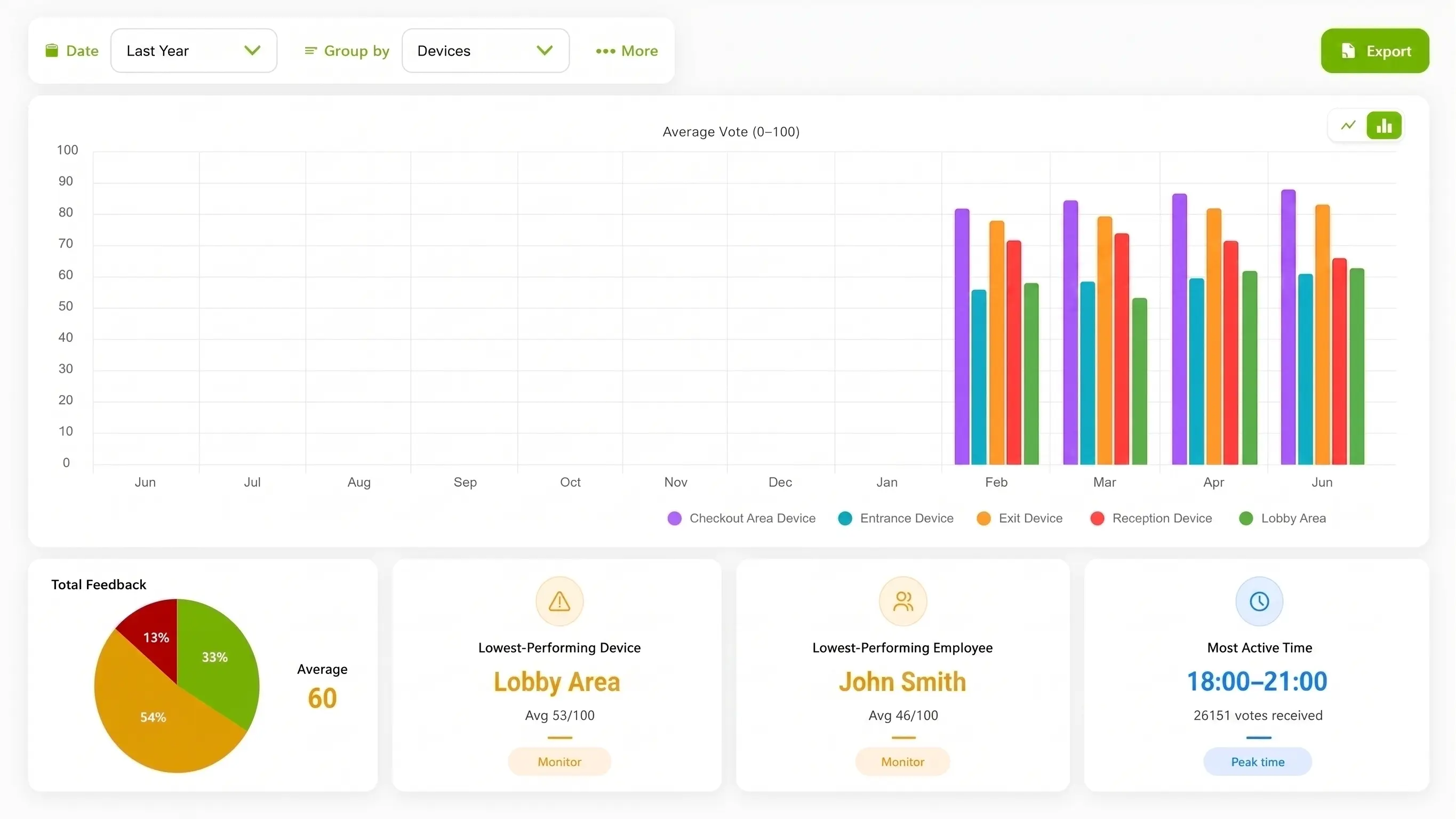
Compare configured service devices and time trends. The example image is product interface imagery, not an OEM CSI result or automotive integration.
Fit with existing programs
Detailed automotive surveys and open-text conversations have a different job from a quick on-site pulse. Keep the roles clear so teams know when to investigate and when to ask for more detail.
| Consideration | ThumbsUp | QR or SMS survey | Existing service process |
|---|---|---|---|
| Customer action | Give a supported gesture at a defined reception or collection point | Open an SMS or web survey and answer several questions | Speak with an advisor or raise a complaint |
| Best fit | A quick indication of the service moment just completed | Detailed satisfaction, comments, and follow-up fields | Immediate resolution or a complex service discussion |
| Operational view | Configured device, location, time, and employee context when schedules exist | The fields and integrations in the survey program | The records created by the service process |
| Important boundary | Does not replace OEM CSI, repair records, or fair performance review | May arrive after the customer has left the site | May not create comparable branch or shift samples |
Service-center pilot
A service leader can make the first test concrete by naming one touchpoint, one operating period, and the evidence that will be reviewed with a low score.
Choose a stationary customer position away from moving vehicles and workshop hazards.
Test mounting, reach, glare, camera distance, and whether staff can avoid influencing the response.
Label devices by service point and compare periods with similar job mix when possible.
Define how the pulse complements CSI, complaints, invoice questions, and customer recovery.
Product and privacy boundary
For automotive service centers, current ThumbsUp documentation says the selfie camera supplies live input for hand-gesture recognition, does not collect biometric data, and that ordinary feedback records do not contain a camera image or video. Review the current Privacy Policy and the service center’s privacy, mounting, and security requirements before deployment.
Read the Privacy PolicyOperational questions for automotive service centers
Match setup to the service moment.
A service center can test a compatible camera-equipped Android tablet at a safe, stationary collection point. After the handover moment, a customer gives a supported gesture, and authorized managers review the score with configured device, location, and time context.
Managers can compare configured devices and time periods and use a difference to choose a review. They should check job mix, waiting, staffing, communication, and customer comments before deciding what caused the pattern.
A short on-site pulse adds a quick signal at the service moment, while a detailed CSI or OEM survey provides broader questions, reporting, follow-up, and program requirements. Use each method for the decision it is designed to support.
When schedules are configured, employee-related results can help focus a fair service review. Managers should combine the signal with the relevant interaction, queue, communication, and operational evidence before choosing an improvement.
More automotive service centers service moments
Bring your reception or collection layout, existing CSI questions, and the service period you want to understand. We can review a safe, clearly bounded pilot.
Discuss the service-center setup