How should a car wash test distance, glass, and lighting?
Validate camera distance, window position, glare, weather, and customer reach at a real car-wash feedback point before expanding a pilot.
Read the guideThumbsUp gives wash operators a touchless way to invite a short service rating at a stationary post-wash point. Separate the wash result from payment, vacuum-area, and membership questions, then review configured device and time patterns.
A wash-exit installation should be tested for a safe stopping point, camera distance, window position, light, weather exposure, and customer reach before regular use.
Choose a stationary post-wash point
Invite a brief gesture
Show a quick confirmation
Set one short service question.
More industry guides
Compare related service moments.
Validate camera distance, window position, glare, weather, and customer reach at a real car-wash feedback point before expanding a pilot.
Read the guideChoose a safe, stationary post-wash point for car wash feedback and keep the result tied to the service moment the customer just completed.
Read the guideUse post-wash feedback to investigate member experience, equipment, queues, and service patterns without treating a score as direct churn proof.
Read the guideCompare a phone-based QR survey with a touchless gesture point for car-wash feedback by service moment, customer effort, detail, and site conditions.
Read the guideMeasure the right wash moment
A post-wash score can be useful only when the operator labels what the customer just completed. Wash outcome, staff help, payment, vacuum access, and membership service can require different questions and different placements.
Place the prompt after the wash when a customer can rate the service moment they just experienced. A score does not prove which part of the wash caused it.
A tunnel exit, in-bay site, and vacuum area have different traffic, distance, light, and stopping conditions. Map the device to the actual point.
Compare like time blocks and locations before deciding what to inspect. A low period is a prompt for an operational review, not a defect diagnosis.
From exit to dashboard
The wash environment decides whether a gesture is practical. Start with the customer path, test a stopped interaction, and keep public reviews and detailed follow-up available for customers who need more space to explain.
Use an exit or vacuum-area position where the vehicle has stopped and the customer can see the prompt.
A customer gives a supported hand gesture instead of typing, scanning, or touching a shared screen.
For car washes, the confirmation display is configured to show for 1 second by default, according to current product documentation.
Authorized managers review the configured device, location, and time context, then investigate the operating conditions.
Placement choices
A useful pilot names one service moment and documents its operating envelope. Use the first location that gives customers a clear view without asking them to interact while moving.
Do not describe a gesture as proven through a windshield until the intended distance, glass, glare, window position, and light conditions have been tested at the real site.
A post-wash stopping point can focus on the completed wash. Validate queue spacing, sight lines, sunlight, and the time available to gesture.
A stationary bay may allow more time, but the rating can reflect vacuum access or site conditions as well as the wash itself.
The exit layout and customer position vary by site. Test the camera angle and whether the customer has a free hand after leaving the bay.
Treat larger vehicles as a separate placement test. Do not assume a car setup transfers to a fleet lane or a different cab height.
Investigate the pattern
Use configured device and time context to find a period worth inspecting alongside equipment notes, queue pressure, staffing observations, or customer comments. The dashboard signal does not detect a wash defect or explain a membership outcome by itself.
Hypothetical operating example
One location shows lower scores during a recurring time block. The manager checks equipment condition, queue pressure, and staff observations for that period. The example does not claim that the gesture identified the cause or linked a rating to a member record.
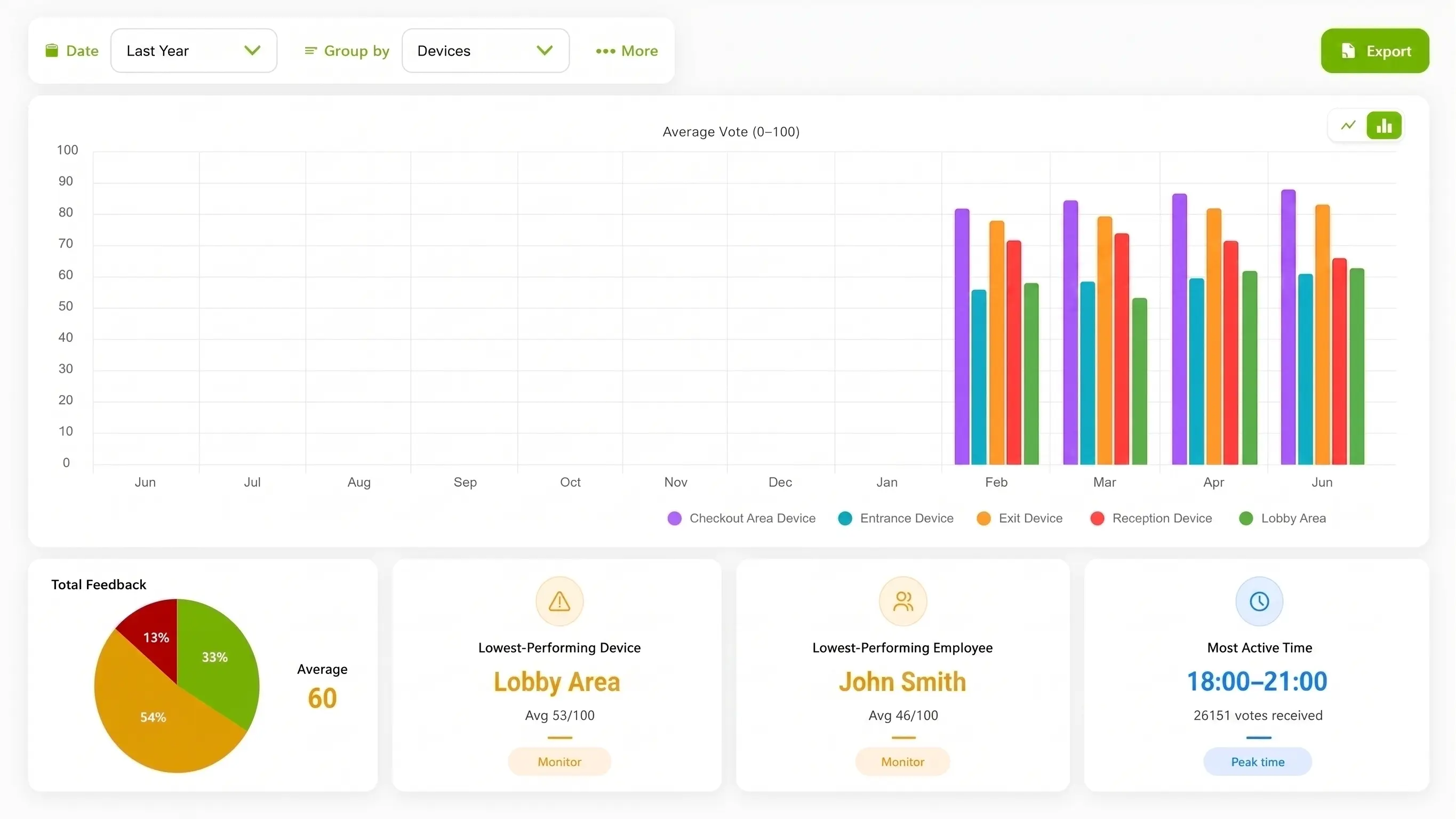
Use the dashboard to review configured feedback devices and historical trends. This product interface image is illustrative and does not show a car-wash customer result.
Choose the right channel
A gesture is one short service signal. QR, SMS, complaint handling, and public review channels support different levels of detail, so define what each channel should answer before a pilot.
| Consideration | ThumbsUp | QR or SMS survey | Existing service process |
|---|---|---|---|
| Customer action | Give a supported gesture at a stationary point | Open a phone flow and complete a form | Use the established complaint or review process |
| Best fit | A quick post-wash pulse at a visible exit or bay | Detailed follow-up when the customer has time and a phone | Public reputation or a longer service conversation |
| What the result means | A configured device and time signal for investigation | Answers to the fields the survey asks | A richer account that may require staff follow-up |
| What it does not replace | Equipment checks, inspections, complaints, or public reviews | A safe on-site touchpoint when phone use is unlikely | A structured, comparable pulse at the service point |
Pilot checklist
Bring the exact vehicle path, mounting proposal, and operating records into the pilot review. A small, well-labeled test makes later location comparisons easier to interpret.
Document where a vehicle can stop safely after the wash.
Test camera distance, angle, glare, water exposure, and customer reach.
Label devices by wash location and define the time blocks to compare.
Record how complaints, public reviews, and equipment checks will be handled.
Product and privacy boundary
For car washes, current ThumbsUp documentation says the selfie camera supplies live input for hand-gesture recognition, does not collect biometric data, and that ordinary feedback records do not contain a camera image or video. Review the current Privacy Policy, retention behavior, mounting requirements, and site rules before deployment.
Read the Privacy PolicyOperational questions for car washes
Match setup to the service moment.
A car wash can test a compatible camera-equipped Android tablet at a safe, stationary post-wash point. A customer gives a supported hand gesture, and authorized managers review the resulting score with the configured device, location, and time context.
It is a different interaction model. A gesture can avoid typing or touching a shared screen at a suitable post-wash point, while a touchscreen or survey may be better when the operator needs more detailed answers. Site conditions decide which channel fits.
A private rating gives an operator an additional service signal while customers remain free to use public reviews or another feedback channel. Keep complaint handling and public-review practices independent and clear to customers.
Test a real stationary position, camera distance, window or open-air view, sunlight, weather exposure, customer reach, queue spacing, repeat-vote controls, and the way managers will investigate a low score.
More car washes service moments
Bring your exit layout, wash moments, and reporting questions. We can review where a touchless gesture point may fit and which conditions need evidence before a wider rollout.
Talk through the wash-exit setup